
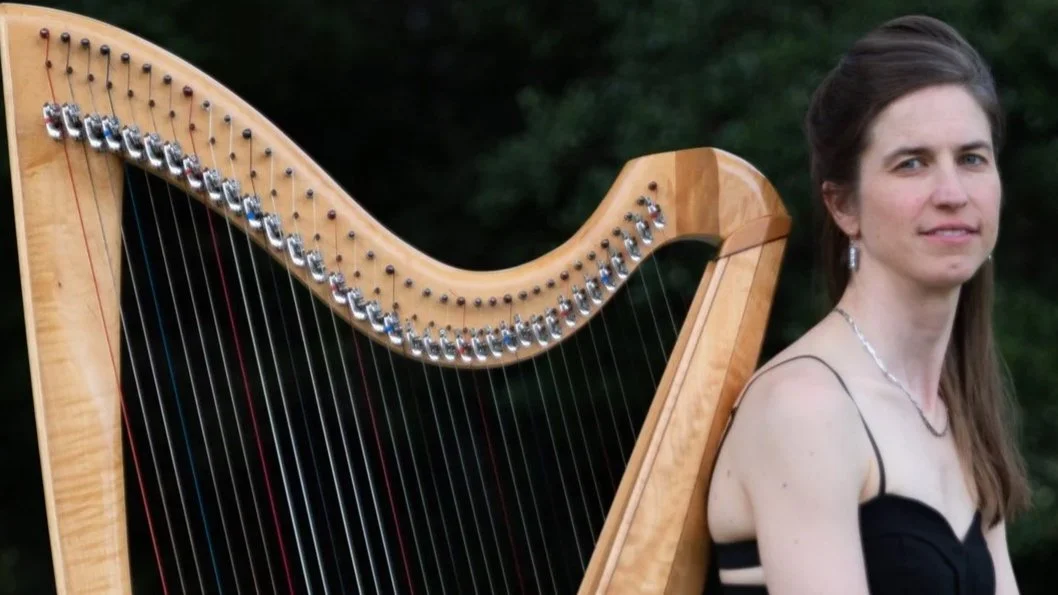
Defying convention, Amelia’s sound touches classical, contemporary and Latin American styles, showcasing the lever harp from new and exciting angles.
The lever harp, often favored by folk musicians, is traditionally used to perform the folk music of Ireland, Scotland, and other regions. In these settings, the levers—small mechanisms at the top of the strings—are typically set to match the key of a song and remain unchanged throughout. By contrast, classical pedal harps allow players to alter notes easily with foot pedals during performance.
Amelia Romano bridges both harp worlds, tackling complex classical works on the lever harp by skillfully shifting levers mid-piece—a remarkable feat to watch. While pedal harps weigh around 80 pounds, lever harps average just 25, making them highly portable. Romano’s musical journey has taken her from a year in South Africa to tours across Europe, the southern United States, and the Pacific Northwest, sharing her passion for expanding the lever harp’s classical potential.
Her latest project, Lever Harp for the Modern Harpist, is a virtual community dedicated to cross-genre, chromatic lever harp arrangements that chart new directions for the instrument. In 2023, she released the album Levers Engaged: Classical Works Re-imagined for Harp and the companion sheet music collection Classical Re-imaginations, showcasing the lever harp as a dynamic voice in classical music. Equally at home composing Latin American–inspired works for solo harp or adapting classical pieces for chamber ensembles, Romano offers virtual workshops and seminars on lever-shifting techniques and strategies for performing chromatic music on the lever harp.
Romano earned her Master’s degree in Classical Lever Harp Performance from San Francisco State University along with a minor in music composition. She has studied with Diana Stork, Anne-Marie O’Farrell, acclaimed Lever Harpist, and Karen Gottlieb, retired harpist of the San Francisco Contemporary Music Players and 2nd harpist with the San Francisco Symphony.
A BIT MORE…
A San Francisco native, she began her lessons on a lever harp, at the age of 9, with Diana Stork, who inspired early compositions, improvisation and playing in a variety of youth ensembles, including the Bay Area Youth Harp Ensemble. She graduated from the San Francisco School of the Arts High School, performing Laura Zaerr’s Celtic Concerto, and releasing her first solo album, Seeking Peace, in her senior year.
Amelia earned a B.A. in Interdisciplinary Field Studies at U.C. Berkeley in 2010, with a thesis examining the legacy of the South Africa apartheid. She continued her harp studies while an undergrad, with Dr. Cheryl Ann Fulton and spent 2010-2011 at Ntonga Music School in Gugulethu Township, Cape Town, South Africa, sponsored by the Playing for Change Foundation.
Amelia’s time in Cape Town connecting and performing in the local music scene gave new purpose to her music life. Upon returning to the US, I formed StringQuake, merging rhythms with music from Latin America and Eastern Europe. A half dozen road trips and international tours later, she identified a burning curiosity for another language: classical music.
In 2015 she joined forces with Iranian vocalist, Dina Zarif, presenting a sound that merges classical and Persian works. We’ve presented our ensemble as a duo, trio and quintet in theaters across the Bay Area - Palace of Fine Arts, Brava Theater and the Asian Art Museum.
From her desire to merge folk and classical traditions, Amelia partnered with a classical trumpeter to form the chamber group, Luminance. Through this collaboration she quickly fell in love with the melodies and chromatic progressions of Chopin and Debussy. Her hunger to speak and understand this language grew by the day. When the pandemic upended the music industry, she returned to school to pursue a classical education at San Francisco State University.
While her formal classical education commenced in August 2020, the seed for her curiosity was born years prior. In 2014, she stumbled upon Barbara Brundage’s book, Classics on Request. This compilation of classics adapted for lever harp was her ticket to exploring this language. Brundage’s adaptation of Clair de lune and Première Arabesque were the perfect invitation to the classical realm. Craving repertoire that might complement the folk rhythms of her childhood, she worked through these compelling adaptations. Amelia sought a vocabulary that honored both traditions.
In January 2023, Amelia completed her master's in music with a focus in classical harp performance under the tutelage of retired second harpist of the San Francisco Symphony, Karen Gottlieb. Immersing herself in harp fundamentals — technique and tools to navigate classical works — she centered her studies around classical adaptations and repertoire, making her own adaptations where necessary. In this process, Amelia compiled a toolkit to approach, and re-work music not intended for levers.
Her latest project and ongoing collaboration, the Romano and Ophir Duo, with clarinetist, Asaf Ophir, explores the bridge between classical and contemporary music styles presenting favorite classical works, from the Baroque era to the present day. Their selections are reimagined with harp, clarinet and flute, offering a fresh new look at classical music, and interwoven with the dynamic flair of Amelia’s original compositions inspired by Latin American rhythms and folk traditions.
With only a couple dozen lever players internationally performing classical and chromatic works — Anne-Marie O’Farrell and Catriona McKay, to name a few — Amelia’s seminars aim to equip lever players with the tools necessary to advancing the lever harp in the classical world. She shares tips in this article published by the Harp Column Magazine, “5 Tips to Solve Chromatic Conundrums on the Lever Harp.”
Photography: Manali Sibthorpe